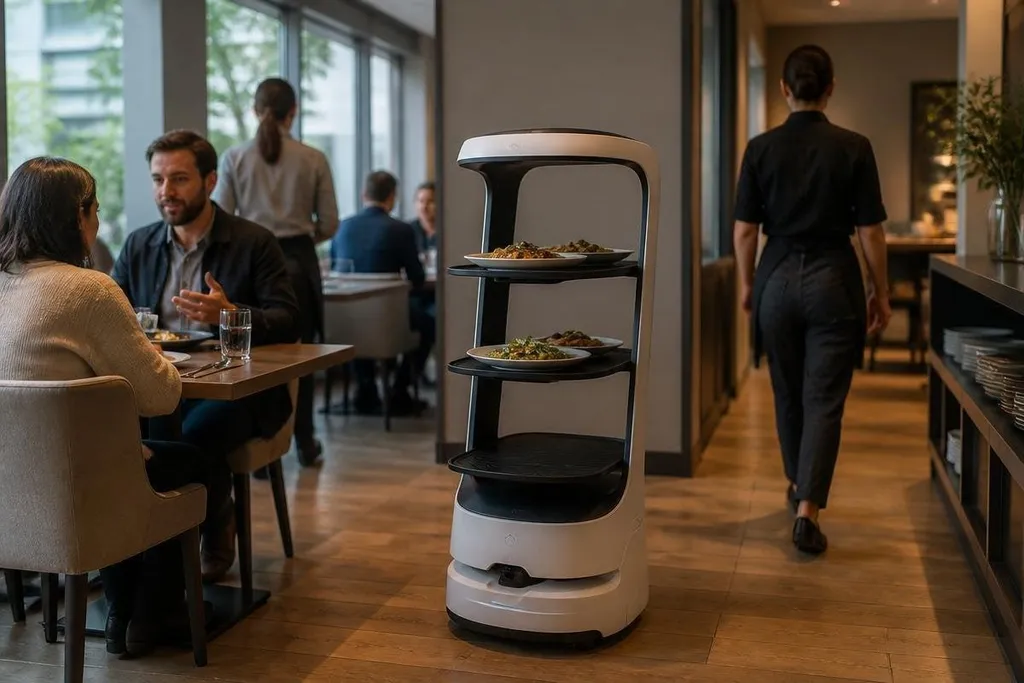
A restaurant robot may carry plates, move supplies, or guide diners to a table. Those jobs sound narrow, and that is the point: the best fit is a repeated task with a clear start and finish. The hard part begins when a busy room, a blocked path, or a customer request breaks that routine.
Quick read
- Repeated transport is the clearest use for a restaurant robot.
- Staff still handle judgment, care, and unusual requests.
- Floor space, cleaning, charging, and safety shape the real cost.
Where robots can help
A robot can carry food between the kitchen pass and service area. It can also move used dishes or take stock between storage and the line. It may use cameras, LiDAR, or other sensors to map nearby objects and choose a safe route. LiDAR measures distance with light, so the robot can detect a chair or person before it moves into that space.
That kind of work takes time from staff without needing much judgment. If a robot carries trays, a server can stay with guests longer, respond to a request, or reset a table. The gain comes from the task it removes, not from the robot's ability to speak or move on its own.
Food preparation is a harder case. A fixed robotic arm can repeat a measured action, such as dispensing an ingredient or placing a container, but it needs a controlled setup. Wet surfaces, changing food sizes, and a tool that needs frequent washing can reduce the value of that system.
The risks on a busy floor
The dining room changes by the minute. A chair moves, a child crosses the room, a waiter stops in a narrow aisle, or a tray sits where the robot expects open floor.
The robot must slow down, stop, or ask for help when its sensors cannot read the scene with enough confidence. That pause affects service. A robot that spends too long waiting may leave staff to make the delivery anyway.
A robot that moves too quickly creates a safety problem around hot food, glassware, and people carrying knives or pans. Cleaning adds another limit, since a unit that works near food needs a clear process for its tray, wheels, sensors, and contact surfaces.
Water, grease, crumbs, and spilled drinks can affect movement or sensor readings. A purchase plan that leaves cleaning out of the daily work schedule is incomplete.
There is also a people problem. Guests may find a robot useful, distracting, or difficult to understand. Staff need a clear way to stop it, move around it, and report a fault. Any system that makes a worker feel trapped between a moving robot and a wall has failed its basic job.
The cost beyond the purchase price
The machine is only one part of the bill. The site also needs a charging point, floor space, software updates, staff training, repairs, and a plan for service when the robot stops working. A narrow doorway or uneven threshold can matter more than a long list of features.
The right comparison is the cost of the task today. Count how many trips staff make, how long each trip takes, and what happens during the busiest hour. Then check whether the robot can complete that work without blocking guests or slowing the kitchen.
A crowded dining room can expose limits that a product video hides: blocked aisles and staff stepping in. Restaurant robotics reporting from Robot24.com can tie those claims to named machines, trial settings, and results before you count the work the robot removes.
I'd skip a restaurant robot bought mainly for its novelty. A machine with one clear job, a safe route, and a service plan has a better case than a general-purpose unit that still needs a person for every step.
A buying checklist
Use these checks before asking for a price:
- Name the task: write down the repeated job, its route, and its busiest period.
- Measure the space: check aisle width, door openings, thresholds, tables, and the charging area.
- Set the stop rule: give staff a visible emergency stop and a clear fault procedure.
- Plan the cleaning: list the surfaces that need cleaning, how often, and with which products.
- Count the human work: include loading, unloading, supervision, charging, and recovery after a fault.
A pilot should run during normal service, not only in an empty room. Track blocked routes, stopped trips, cleaning time, staff interventions, and tasks finished without a person taking over. The useful number is the work completed during a real shift.
The next decision is practical: can the robot finish one repeated task for a full service period, with its safety and cleaning work included? If the answer is no, the restaurant needs a better process before it needs a robot.